

Every now and then, I say something that sounds so truly profound that I wonder if it really came from me in the first place. I had that experience recently while writing a young artist and was so blown away by this revelation that ace to me that I wanted to share it with you readers here. The young artist in question is a conceptual artist, who also is dabbling in photorealism. Following is my reaction to what he told me about himself.
THE LETTER
I believe it's good for artists to have a photorealism base. It's a great place of departure even for conceptual or abstract artists. Artists have to have some type of springboard to jump off of even if they're jumping into the void. That springboard seves as an anchor point for them to refer back to, otherwise IMO, their work becomes a chaotic mess that makes sense to no one but themselves.
No matter how independent an artist believes himself to be, he must realize or at least be honest enough to admit the he is creating art for SOMEONE no matter how narrow the audience.
If an artist s truly doing it just for him or herself, then they would never share their work with anyone.
And that's fine too.
Art is a profoundly human thing.
Elephants don't ponder what beautiful lines they're going to make with their trunks, nor do rattlesnakes wonder if they're "rattling on beat" only humans do that. And we do it on a primal level because it's pleasing to us.
Remember to always make art tat pleases you. First.

Subscribe To Subwaysurfer.blogspot.com to find out what Elgin is up to!

 Posts
All Comments
Posts
All Comments
Wednesday, February 08, 2012


Saturday, February 04, 2012
DOG EAT DOG IPAD ILLUSTRATION

I was in the mood to draw today and thought I'd illustrate this old, tired cliche. It's a Dog Eat Dog World. I thought it would be too much to draw a globe, so I opted to draw the dog in corporate attire. I figured the expression probably originated in the business works anyway.
The illustration was originally drawn in pen and ink, using a Pitt artist brush pen, scanned into the iPad, and airbrushed using using the art studio app.
Friday, February 03, 2012
BOOK REVIEW: SUBWAYSURFER Extreme life drawing on da train
Doing a plug here for the book I pulished featuring a collection of subway inspired drawings of mine during the 2006-2008 period. I was really into my extreme exaggeration drawing phase during this time, so the art reflects that. I use the mediums of pen and ink, graphite, colored pencils, and Prismacolor art stixx in the book, and there is some commentary. Hard copies can be obtained through blurb.com and an EBOOK version is also available on ths site by going to the ebooks and products link on the right side f the blog page.
EXAGGERATED BLUE MAN IPAD CARICATURE

THE KIDS STILL GOT IT!
While looking through some of my old books I found an exaggerated sketch that I think I missed posting. I threw t into the iPad, did a little digital coloring using the ArtStudio App, and came out with this masterpiece. I don't remember tge gentleman that I drew, but I'm sure I saw him on the subway. Undoubtedly this was done during my profile drawing period."
Thursday, February 02, 2012
MEMORIES OF BUTCHE DOG

A friend is one who is always happy to see you come and sad to see you go.
It's been a full week now, and I still find it so hard to let go of my best friend, my Beloved "Staffie" Butchie Dog.
He was fourteen years old.
"Beloved" is one of those words that you don't hear spoken much. It's most often written and read. It's like a sacred word, reserved only for those souls that touch our lives so deeply that their love for us, and ours for them transcend words.
Butchie Dog was 14 years old.
That's 14 Christmases , 14 New Years Days, 14 4th of Julys, and 14 years of quiet loving companionship.
As I've said numerous times in this Blog, being an artist can be a lonely life sometimes. Unlike regular nine to fivers, there's no daily morning commute, no ganging around the water cooler with your co withers, no confrontations with your boss... It's just you alone in an empty studio, with a sheet of paper, a computer screen, and the radio with the volume turned up for company.
To break up the monotony you can go out on location, see clients, or even have an occasional friend stop by, but the sat majority of time, it's just you a d the sound of silence.

For me, Butchie Dog filled up that silence. As I bent over my computer screen today banging out another late assignment, I found my eyes becoming wet with tears as I started to miss that old familiar sound of him coming down the stairs, and finally aging at my feet like a dog skin rug. I can still feel his cold, wet dog nudging my my ankle, reminding me that it was time for his morning walk. I would complain to him on cue, about needing to get my work done, but always felt more refreshed having gotten fresh air from our morning romps. I always took special pleasure in feeding him, because he had this curious way of "thanking me" for his food. He would always tae a few bites, then stop cold, pause ad turn in my direction making eye contact for a couple of seconds before returning to his meal. That's way too much thinking, for a dog"I used to say to myself, but Butchie Dog apparently did a lot of thinking!
I recall the first couple if months wen we got him, and tried to put him in a cage when we keft home. Wed come back hours later and found him on the coach fast asleep. I was always reprimanded for leaving the latch unlocked, until one day I returned home unexpectedly a few minutes after leaving, to find him slipping out the cage, by squeezing his body through an impossibly narrow opening until the match was released.
After that incident,he was awarded his freedom and had full run of the house!
One time we wished we hadn't done that. As he got older, he began to suffer from serration anxiety, and couldn't be left alone. I left the house one morning and returned to find the plaster near the front doing literally eaten away, exposing wiring and wood underneath, a bathroom door knob crushed like aluminum foil, and numerous shredding of door frames.
It officially became my job. To stay with Butchie Dog after that (which I was doing anyway) and the only time I could leave for appointments, was by meaning him with a boarding service at the local pet shop for days ad weekends.
Did I mention how he single handedly escaped not only from his cage one night, and also set free EVERY OTHER DOG IN THE PET SHOP TOO???
The owner found it so hilarious that he never even penalized us.
Lots of good memories...
I'll always miss the fact that he'd be here to comfort me when I was sick. Especially when i got so sick I'd be in bed for hours and hours, never complaining to go to the barroom, never demanding to be fed.
He'd just wait for me to Be Better and we both would take it from there.
When i noticed the timings growing on his body i tried to ignore it. When I noticed him becoming winded after our walks, I pretended not to notice. wen I would see him stumble walking down a flight of stairs, or whimper on the couch in pain, I'd pretend not to hear.
But that day at the vet one week ago, I could no linger deny it.
My friend was dying. Bit by bit. Slowly and painfully.
I had to let him go, and because I knew that this was the last time I would see him, I couldn't bear to even look in those eyes again.
I didn't want that memory.
I wanted the memory of long walks in the summer. Of digging paths for him to walk in the winter snow, of watching him endure having reindeer horns put on him on Christmas Eve, of listening to him snore at my feet while I drew, and of him slowly, painfully purposefully climbing the stairs that lead to my bedroom just because he couldn't bear not to be near me.
That's love.
And that's what I'm going to miss the most.
Goodbye Butchie Boy.
Thank you.
I love you.
And I'll miss you every day.,

HERES A POST AND CARTOON I DID LAST YEAR OF BUTCHIE WHEN HE WAS THIRTEEN

from a vet visit, he came into the living room, and was so happy to see his dinner waitiong, that he wagged his tail stuck out his tongue and held this pose for a couple of seconds, long enough for me to get just the gesture drawing I needed to make this great Doggie Caricature
Tuesday, January 31, 2012
Monday, January 30, 2012
Thursday, January 26, 2012
Friday, January 20, 2012
IS USING TECHNOLOGY TO DRAW EXAGGERATED CARICATURES CHEATING?
A CONTROVERSIAL SUBJECT
One night while playing with my wives new iPad 2, I discovered a neat little application called photo booth. This crazy app enables the user to manipulate photos using filters that stretch, squash, and contort, in tge sane way Photoshop filters do in one eat step. I became intrigued and took a photo of myself and started playing. Instantly it struck me how surprisingly simple these "photo caricature" were to create, and brought back to mind a question I asked on a caricature forum I frequented several years ago.
IS using technology to draw caricatures cheating? I even went as far as to pose the question if any of the artists on the forum had ever used Photoshop, or another photo manipulation program to give them an edge over other computer illiterate artists who struggled doing exaggerations the old fashioned way, namely using our imagination. The overwhelming majority insisted they never used technologhy, except for one prominent artist (who really is brilliant and no doubt can draw outta his head)who confessed that e had used technology occasionally to enhance a drawing, and to solve visual problems.
WHY THE OUTRAGE
At the time, I suspect that along with my peers who were against the practice of using the computer to "help out" we felt that whoever did so. Want being a "real artist" as we loos,y defined as one who used their own hand, brains, and imagination to create works of art. We were the "caricature purists" who were holding to a higher standard.
But there was also a very real fear....
Those of us, like me, who had struggled sooooo hard to "crack the exaggerated code" took pride in the fact that we had labored hard and long to achieve our level of proficiency. While there were many talented, competent artists in our tribe, only a select few were able to achieve those wonderfully grotesque caricature renditions that simultaneously resembled the subject, and a creature from outer space. The air we few breathed in sitting upon Mount Olympus was rare, and sweet!
But that blasted photo editing software everything! with it, even the modestly talented neophyte could achieve dreams of Exaggerated caricature glory! And unlike us poor souls who labored to obtain this exalted knowledge, they could do so in less than half the time!
The other fear was that people who possessed no talent at all, could now, with this diabolical device, thumb their noses at us caricature artists, and exclaim" who needs YOU?? We can now create our OWN caricatures!"
Yeah.... I was a purist, alright.....but recently, as I've grown older, and more open to new ideas, I've begun to re examine if I've been too hasty in condemning the use of technology to create caricatures. They way I see it now, there are actually some real advantages.

TECHNOLOGHY ISN'T "BAD"
Is technology really bad to create art with? If I'm honest, I really would have to conclude it isn't. Like most artists I've used technology to scan my pictures, clean up my sketches, juxtapose images together, re size them, and of course color them. If any purist would come up to me and say I wasn't a "real"artists because I wasn't using rulers to resize, or mixing my own paint I'd totally ignore them on the way to picking up my check from a satisfied client. While I can't cite any examples now, it's safe to say that artists have AKWAYS used the available technologhy of their day to enhance their work, or make it simpler to execute. In our day, that tool just happens to be the computer. With so many other people
In other industries from accounting to zoologhy using it to enhance their performance, we would be nuts to neglect it.
YOU CAN'T DRAW WHAT YOU CAN'T SEE
One time as a beginning artist, I was asked to draw a picture of a unicorn which as everyone knows s really just a horse with wings and a forehead horn. Simple. Or so I thought. When I was told I had drawn it wrong, I was a little confused... I knew what a horse looked like, having seen them in person and pictures I internalized an image in my head I could recall at will. What I neglected to realize, however was that the front and the back legs were wry g. Apparently I hadn't noticed noticed that the back legs of such animal was different from the front. I literally could t draw that, because I couldn't visualize, which means I didn't see it! And the source I was using was my imagination.

DRAWING FROM THE IMAGINATION SCREEN
Whenever we decide to draw a subject in an exaggerated way, we do two things. First and foremost, we look at the subject objectively to see what they look normally. At this stage, we aren't applying a subjective opinion about the face's individual parts, we take everything in as a whole, first. After we've gotten a good look we start to look for facial "flaws", promise t attributes, etc. Finally once we've got that info, we start to imagine the face stretched pulled, and Shawnee based on the info we've obtained in the previous stage. This process happens quicker than it takes to write or tell, but it does happen. We draw based on what we see with our eyes, objectively, and also what we superimpose whats in our imagination. The level of exaggeration is keft up to the individual artist, but for the purpose of this article, I'm talking about extremely distorted exaggeration like my "peanut head shape"photo here.

AN EASIER WAY TO LEARN EXAGGERATION
Before I continue, let me stress that although you certainly can throw a photo into an image editing program, and trace or copy it to get a likeness quickly. I'm advocating using the tecnologhy as a tool to help you visualize the concept of exaggeration. Let's face it.for the average artist, doing exaggerated work is challenging. Some get close to understanding it, while others never seem to understand it. Master exaggerators often speak of maintaing proper relationships in the face when we stretch pull or squeeze. It's a ard concept though to visualize and remember if you don't have a picture to look at and imprint. In the aforementioned photo, my image is forced into a peanut shape, where the forehead and lower part of my face are ballooned out, and the middle is pinched in. By viewing the oho to, one can easily see what happens to the corresponding facial features of eye brows, eyes, nose mouth, even my goatee "react" when forced into that peanut shaped container. The same can be equally seen when my face is forced into an egg shape and a square shape. by taking your face or any for that matter, and playing around with it, you will get a "feel" for how the corresponding facial features are likely to react when subjected to a given geometric container. In short they will be locked into your imagination, and now that you can "see" what a given exaggerated face is likely to look, you can impose that principle on the current face you are observing.
I realize this approach is a mechanical one, but it's a starting point, a way of training your mind to look through a fun house mirror just a little faster than if you'd have to conjure up the image on your own.

A GREAT TOOL FOR FANTASY ART AND CHARACTER DESIGN
If youve ever been commissioned to draw fantasy. Type art, you know how difficult that can be.
The trick is to create alien characters no one has seen before, but still contain a certain kind of "reality". While some may find this easy to do without a visual aid, if you're like me, you more than likely end up drawing a stereotypical green colored alien with three round eyes and two antentaes on top of the head.
Playing around with a variety of faces in photo manipulation software provide you with endless options so that you can make alien critters so grotesque, you puke on your keyboard. Once you are satisfied with your character, simply copy it, with the confidence that you are not plagiarizing someone elses character.

EMBRACE THE PRESENT
regardless of how you feel about art and computer technologhy, the fact is that this tool is here to stay. As artists WE ARE SUPPOSED TO BE THE CREATIVE ONES! And that means having the desire and ability to use whatever tools the culture gives us to our advantage. If we can find a way to enhance our work, to do it faster and easier, there's no reason why we shouldn't. Photo imaging software is nothing more than using a specialized brush or pen to get our work done.and that should be what's most important to any artist. Getting the work done.
I'd appreciate your thoughts on this. All opinions, pro and con are welcome and encouraged.
One night while playing with my wives new iPad 2, I discovered a neat little application called photo booth. This crazy app enables the user to manipulate photos using filters that stretch, squash, and contort, in tge sane way Photoshop filters do in one eat step. I became intrigued and took a photo of myself and started playing. Instantly it struck me how surprisingly simple these "photo caricature" were to create, and brought back to mind a question I asked on a caricature forum I frequented several years ago.
IS using technology to draw caricatures cheating? I even went as far as to pose the question if any of the artists on the forum had ever used Photoshop, or another photo manipulation program to give them an edge over other computer illiterate artists who struggled doing exaggerations the old fashioned way, namely using our imagination. The overwhelming majority insisted they never used technologhy, except for one prominent artist (who really is brilliant and no doubt can draw outta his head)who confessed that e had used technology occasionally to enhance a drawing, and to solve visual problems.
WHY THE OUTRAGE
At the time, I suspect that along with my peers who were against the practice of using the computer to "help out" we felt that whoever did so. Want being a "real artist" as we loos,y defined as one who used their own hand, brains, and imagination to create works of art. We were the "caricature purists" who were holding to a higher standard.
But there was also a very real fear....
Those of us, like me, who had struggled sooooo hard to "crack the exaggerated code" took pride in the fact that we had labored hard and long to achieve our level of proficiency. While there were many talented, competent artists in our tribe, only a select few were able to achieve those wonderfully grotesque caricature renditions that simultaneously resembled the subject, and a creature from outer space. The air we few breathed in sitting upon Mount Olympus was rare, and sweet!
But that blasted photo editing software everything! with it, even the modestly talented neophyte could achieve dreams of Exaggerated caricature glory! And unlike us poor souls who labored to obtain this exalted knowledge, they could do so in less than half the time!
The other fear was that people who possessed no talent at all, could now, with this diabolical device, thumb their noses at us caricature artists, and exclaim" who needs YOU?? We can now create our OWN caricatures!"
Yeah.... I was a purist, alright.....but recently, as I've grown older, and more open to new ideas, I've begun to re examine if I've been too hasty in condemning the use of technology to create caricatures. They way I see it now, there are actually some real advantages.

TECHNOLOGHY ISN'T "BAD"
Is technology really bad to create art with? If I'm honest, I really would have to conclude it isn't. Like most artists I've used technology to scan my pictures, clean up my sketches, juxtapose images together, re size them, and of course color them. If any purist would come up to me and say I wasn't a "real"artists because I wasn't using rulers to resize, or mixing my own paint I'd totally ignore them on the way to picking up my check from a satisfied client. While I can't cite any examples now, it's safe to say that artists have AKWAYS used the available technologhy of their day to enhance their work, or make it simpler to execute. In our day, that tool just happens to be the computer. With so many other people
In other industries from accounting to zoologhy using it to enhance their performance, we would be nuts to neglect it.
YOU CAN'T DRAW WHAT YOU CAN'T SEE
One time as a beginning artist, I was asked to draw a picture of a unicorn which as everyone knows s really just a horse with wings and a forehead horn. Simple. Or so I thought. When I was told I had drawn it wrong, I was a little confused... I knew what a horse looked like, having seen them in person and pictures I internalized an image in my head I could recall at will. What I neglected to realize, however was that the front and the back legs were wry g. Apparently I hadn't noticed noticed that the back legs of such animal was different from the front. I literally could t draw that, because I couldn't visualize, which means I didn't see it! And the source I was using was my imagination.
<="">
;
U;

DRAWING FROM THE IMAGINATION SCREEN
Whenever we decide to draw a subject in an exaggerated way, we do two things. First and foremost, we look at the subject objectively to see what they look normally. At this stage, we aren't applying a subjective opinion about the face's individual parts, we take everything in as a whole, first. After we've gotten a good look we start to look for facial "flaws", promise t attributes, etc. Finally once we've got that info, we start to imagine the face stretched pulled, and Shawnee based on the info we've obtained in the previous stage. This process happens quicker than it takes to write or tell, but it does happen. We draw based on what we see with our eyes, objectively, and also what we superimpose whats in our imagination. The level of exaggeration is keft up to the individual artist, but for the purpose of this article, I'm talking about extremely distorted exaggeration like my "peanut head shape"photo here.

AN EASIER WAY TO LEARN EXAGGERATION
Before I continue, let me stress that although you certainly can throw a photo into an image editing program, and trace or copy it to get a likeness quickly. I'm advocating using the tecnologhy as a tool to help you visualize the concept of exaggeration. Let's face it.for the average artist, doing exaggerated work is challenging. Some get close to understanding it, while others never seem to understand it. Master exaggerators often speak of maintaing proper relationships in the face when we stretch pull or squeeze. It's a ard concept though to visualize and remember if you don't have a picture to look at and imprint. In the aforementioned photo, my image is forced into a peanut shape, where the forehead and lower part of my face are ballooned out, and the middle is pinched in. By viewing the oho to, one can easily see what happens to the corresponding facial features of eye brows, eyes, nose mouth, even my goatee "react" when forced into that peanut shaped container. The same can be equally seen when my face is forced into an egg shape and a square shape. by taking your face or any for that matter, and playing around with it, you will get a "feel" for how the corresponding facial features are likely to react when subjected to a given geometric container. In short they will be locked into your imagination, and now that you can "see" what a given exaggerated face is likely to look, you can impose that principle on the current face you are observing.
I realize this approach is a mechanical one, but it's a starting point, a way of training your mind to look through a fun house mirror just a little faster than if you'd have to conjure up the image on your own.

If youve ever been commissioned to draw fantasy. Type art, you know how difficult that can be.
The trick is to create alien characters no one has seen before, but still contain a certain kind of "reality". While some may find this easy to do without a visual aid, if you're like me, you more than likely end up drawing a stereotypical green colored alien with three round eyes and two antentaes on top of the head.
Playing around with a variety of faces in photo manipulation software provide you with endless options so that you can make alien critters so grotesque, you puke on your keyboard. Once you are satisfied with your character, simply copy it, with the confidence that you are not plagiarizing someone elses character.

EMBRACE THE PRESENT
regardless of how you feel about art and computer technologhy, the fact is that this tool is here to stay. As artists WE ARE SUPPOSED TO BE THE CREATIVE ONES! And that means having the desire and ability to use whatever tools the culture gives us to our advantage. If we can find a way to enhance our work, to do it faster and easier, there's no reason why we shouldn't. Photo imaging software is nothing more than using a specialized brush or pen to get our work done.and that should be what's most important to any artist. Getting the work done.
I'd appreciate your thoughts on this. All opinions, pro and con are welcome and encouraged.
Wednesday, January 18, 2012
WHATS THE BEST MARKER TO USE?
WHAT IS THE BEST MARKER TO USE???
Ah! This age old question is asked of me more than any other, especially by beginning artists. I don't mind answering the question,(well, obviously since I'm writing an article) but sometimes I can't help laughing inwardly whenever the question is asked. Usually the question gets asked whenever a person finishes viewing a particular piece of work drawn seen online or drawn in person. The question is funny to me because I feel it's not REALLY what the person is, or should be asking. I feel what they really want to know is what technique I used to make the picture look humorous, exaggerated or interesting? How do you get "life" into the drawing? Why does it have a sense of movement? How do you get that dynamic quality in your work?
Asking What's the best marker to use, is akin to the Harry Potter villain, Voldermort, seeking the Power of The Elder Wand.
The truth is, it AIN'T THE WAND, in this case, it's the skill of the Magician.
At least, in part.
Markers are tools(which vary from one artist to another) that enable us as artists to do a job easier, that's all. They, in themselves don't do the job for us. There are tools that are better suited for what I happen to be drawing. For instance, if I HAD to limit myself to ONE marker to use for live party caricature, I would have to revert back to childhood....

CRAYOLAS AIN'T JUST FOR KIDS
Crayolas are, hands down, my favorite marker for live drawing. Don't get me wrong, I love Markettes, Tombo Brush Pens, and Chart Paks, too, but CRAYOLA holds a special place in my heart.
First off, it's how they make me feel, emotionally.
 Whenever I draw with them, It feels like I'm getting ready to play, not work. I've watched caricature artists who draw exceptionally well, technique wise, but sometimes their faces are contorted in this mask of intense concentration, as the do their "job". For me I want party work to seem like fun, not labor, and this is exactly the tool I need to get me into that space.
Economically, the price of the markers can't be beat. Three to five bucks for a pack of ten. If you shop for pens regularly, you know how they eat into your budget.It could be argued that I'm not saving money, if I'm just using the color, Black from the box, but I use the dark colors if purple, blue ad brown as well with equal success and appreciation. People being drawn feel they're getting a color drawing, even though I'm just doing line. Another great way to save money is to wait until Kate August when Staples has their Back To School Sales. You can get the ten box for. As love as .99 at some locations!
Convenience wise, the Crayolas can be obtained from a variety of locations. You can't buy Tombo Brush lens from your local mom and pop candy store, CVS Pharmacy, Target, Duane Reade, or the stationary isle of your Super market, can you? This availability alone has saved me on numerous occasions wen I had forgotten my markers and couldn't get to a name brand Art Store.
Saving money, and Convienience are important factors, but what about functionality? How do these tools really perform in the field? I thought you'd never ask!
SUPERIOR LINE QUALITY
Even with ne ranting on about the skill of the artist, blah, blah, blah, earlier, I must say that the CRAYOLA, in the hands of a trained professional, deliver a quality if line so elegantly, that I come close to weeping looking at my completed drawings.
 The secret of this superior line quality us found in the markers wonderf
ul conical tip. This conical tip is unbelievably durable, and might be expected, since it was designed to withstand the pounding of children. It works great for adults like me would are notorious for "heavy handedness" when we draw. With just minor adjustments of your ha d, you can get a curved calligraphic line, a fine thin line, or a bold massive one.unlike other pens whose tip usually loses some of it's firmness after a couple of drawings, I've used these tips until they've comp,etey dried out and they still hold their shape, This is definitely the kind of marker you want if you have a long line f people, find yourself in a zone" and don't have time to change markers, lest you break your flow.
LETS NOT FORGET PAPER
.
I must admit, that not all drawing surfaces are CRAYOLA Marker friendly. All if the aforementioned be benefits of using the marker will fade away like your childhood dreams uf you use the wrong paper, stay away from papers that have a lot if tooth to them. You want your paper to have a smooth finish. Glossy paper works best of course, but can be pricey. I recommend card stock and cover stock paper that can be purchased at Staples ranging from 8X11 in size, to 11X17. The price us very reasonable for either size, the paper is sturdy, and you will have saved the life of a marker.
Oh yeah...good old notebook paper like I'm using in the photo works great too! I use notebook paper when I'm practicing. It saves money on sketchpads... Recession ya know...a mans gotta save money....
THE WRAPUP
I hate to get all corny on ya and conclude that no marker is really the best, it all depends on YOU! So I won't. I will say for certain jobs like the one I described, live party caricature, there are markers that ARE better. Yeah, I'm taking a stand.... Argue me down if you must.....
Ah! This age old question is asked of me more than any other, especially by beginning artists. I don't mind answering the question,(well, obviously since I'm writing an article) but sometimes I can't help laughing inwardly whenever the question is asked. Usually the question gets asked whenever a person finishes viewing a particular piece of work drawn seen online or drawn in person. The question is funny to me because I feel it's not REALLY what the person is, or should be asking. I feel what they really want to know is what technique I used to make the picture look humorous, exaggerated or interesting? How do you get "life" into the drawing? Why does it have a sense of movement? How do you get that dynamic quality in your work?
Asking What's the best marker to use, is akin to the Harry Potter villain, Voldermort, seeking the Power of The Elder Wand.
The truth is, it AIN'T THE WAND, in this case, it's the skill of the Magician.
At least, in part.
Markers are tools(which vary from one artist to another) that enable us as artists to do a job easier, that's all. They, in themselves don't do the job for us. There are tools that are better suited for what I happen to be drawing. For instance, if I HAD to limit myself to ONE marker to use for live party caricature, I would have to revert back to childhood....

CRAYOLAS AIN'T JUST FOR KIDS
Crayolas are, hands down, my favorite marker for live drawing. Don't get me wrong, I love Markettes, Tombo Brush Pens, and Chart Paks, too, but CRAYOLA holds a special place in my heart.
First off, it's how they make me feel, emotionally.

Economically, the price of the markers can't be beat. Three to five bucks for a pack of ten. If you shop for pens regularly, you know how they eat into your budget.It could be argued that I'm not saving money, if I'm just using the color, Black from the box, but I use the dark colors if purple, blue ad brown as well with equal success and appreciation. People being drawn feel they're getting a color drawing, even though I'm just doing line. Another great way to save money is to wait until Kate August when Staples has their Back To School Sales. You can get the ten box for. As love as .99 at some locations!
Convenience wise, the Crayolas can be obtained from a variety of locations. You can't buy Tombo Brush lens from your local mom and pop candy store, CVS Pharmacy, Target, Duane Reade, or the stationary isle of your Super market, can you? This availability alone has saved me on numerous occasions wen I had forgotten my markers and couldn't get to a name brand Art Store.
Saving money, and Convienience are important factors, but what about functionality? How do these tools really perform in the field? I thought you'd never ask!
SUPERIOR LINE QUALITY
Even with ne ranting on about the skill of the artist, blah, blah, blah, earlier, I must say that the CRAYOLA, in the hands of a trained professional, deliver a quality if line so elegantly, that I come close to weeping looking at my completed drawings.

ul conical tip. This conical tip is unbelievably durable, and might be expected, since it was designed to withstand the pounding of children. It works great for adults like me would are notorious for "heavy handedness" when we draw. With just minor adjustments of your ha d, you can get a curved calligraphic line, a fine thin line, or a bold massive one.unlike other pens whose tip usually loses some of it's firmness after a couple of drawings, I've used these tips until they've comp,etey dried out and they still hold their shape, This is definitely the kind of marker you want if you have a long line f people, find yourself in a zone" and don't have time to change markers, lest you break your flow.
LETS NOT FORGET PAPER
.
I must admit, that not all drawing surfaces are CRAYOLA Marker friendly. All if the aforementioned be benefits of using the marker will fade away like your childhood dreams uf you use the wrong paper, stay away from papers that have a lot if tooth to them. You want your paper to have a smooth finish. Glossy paper works best of course, but can be pricey. I recommend card stock and cover stock paper that can be purchased at Staples ranging from 8X11 in size, to 11X17. The price us very reasonable for either size, the paper is sturdy, and you will have saved the life of a marker.
Oh yeah...good old notebook paper like I'm using in the photo works great too! I use notebook paper when I'm practicing. It saves money on sketchpads... Recession ya know...a mans gotta save money....
THE WRAPUP
I hate to get all corny on ya and conclude that no marker is really the best, it all depends on YOU! So I won't. I will say for certain jobs like the one I described, live party caricature, there are markers that ARE better. Yeah, I'm taking a stand.... Argue me down if you must.....
Sunday, January 15, 2012


Friday, January 13, 2012
HIP HOP ELF Cartoon by Elgin Subwaysurfer Bolling
I was in a playful character creating mood today, so I decided to draw my version of an Elf. As a kid, the Elves I remember were all happy little critters, and some were a little mischievous. I decided to up this mischievous level a couple of notches, turning my Elf into a doo rag wearing, gold teeth and ear ring sporting, sneaker wearing, hip hop graffiti tagged Elf complete with spray can.
BLACK AND WHITE SKETCH
 I drew this simply using a very thin line, knowing I was going to digitally paint it in art studio. I imported the initial sketch(not shown) into the art studio app, by first taking a photo of it ane emailing it to myself. I then meticulously traced the sketch until everything was in place exactly the way I wanted.
ADD FLAT AREA OF COLOR
 Know lay down the basic colors that I'm going to shade in later to give the picture a more three dimensional feel.if I was doing basic animation, where I had to draw this hundreds f times, this would generally be the end. Thankfully, I'm not done yet!
SHADING STAGE
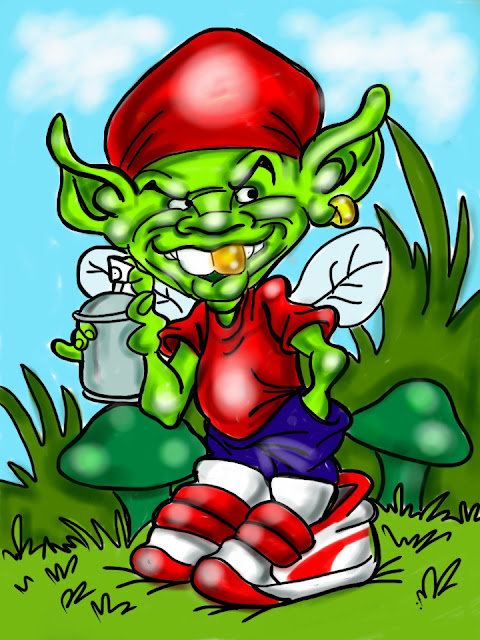 The shading stage is where I especially start to get excited. I always enjoy seeing the fat colored picture start to pop as I begin to add highlights and shading. Often times at this stage, I get new ideas for the sketch that I hadn't thought of previously. Initially I thought it would just be comical to give my youthful Elf Boy big bucked teeth, but once I decided to make one tooth gold, it enhanced that whole hip hop vibe I was going for.
FINISHING TOUCHES
 In the final stage I pay close attention to the eyes adding more shadow to make them slightly more menacing. I also purposely add more white highlights which for me, is reminiscent on how Grafetti artists used to color their pieces. Believe it r not, a lot of my color inspiration comes from observing and copying the way artists color the crazy characters you see inhabiting your breakfast cereal boxes! Have you looked at the way Captain Crunch is colored lately? It's absolutely breath taking!
To complete the pic, I've added yellow spray mist to the spray can,and f course it would be complete with showing how hes tagged the two mushrooms in the background.
What I love about this character is that he can easily be turned into a comic char act that I can build a story around. Now if I can only think of a name?...
BLACK AND WHITE SKETCH

ADD FLAT AREA OF COLOR

SHADING STAGE

FINISHING TOUCHES

To complete the pic, I've added yellow spray mist to the spray can,and f course it would be complete with showing how hes tagged the two mushrooms in the background.
What I love about this character is that he can easily be turned into a comic char act that I can build a story around. Now if I can only think of a name?...
Wednesday, January 11, 2012
THE ART OF TEACHING ART part three by Elgin SUBWAYSURFER Bolling

YOU ARE THE MASTER
Ever heard the expression,"jack of all trades, master of none?" its seems like a good idea to be a "jack" initially, I admit. After all, if you know a little bit about a variety of subjects, then you will be versatile enough to do whatever a client calls for! What's wrong with that?? Well, while you WILL get a couple of assignments, you may not feel entirely comfortable doing that particular thing. For instance, I can DO background drawing, but it's a labor intensive activity for me, as opposed to cartooning and caricature which I can do in my sleep. When a client hires you to do a job, they're not expecting a generalist, they're expecting a master, who not only knows their subject inside out, but can even re invent and re adjust on the fly. When you are teaching, you don't want there to be any guesswork. You also want to have fun! Strive to teach on the subject that you KNOW. Doing so will help you develop your own niche, and it's this Niche which will focus you and make you stand out from the pack.
TEACH ON A SPECIFIC TOPIC

When I first began teaching art I was so excited to have the job, I started teaching "everything" I knew about the subject in the first session! I talked endlessly, never passing to take a breath, switched from one aspect of my subject matter to the next, gave multiple examples to accent my points, and sincerely wondered why I was getting blank stares.
PEOPLE ARE NOT MACHINES
The one thing that must always be remembered when teaching is that your audience doesn't know what you know. For many, this will be the first time they've been introduced to your subject, and they cannot be overloaded with too much information. THEY WILL NOT RETAIN IT! It's best when teaching, to teach on one or two topics and explore those topics from a variety of angles. It may seem like you will not fill up your allotted time if you teach only one or two things, but don't forget that you will be lecturing, demonstrating, having your class do hands on exercises, evaluating their work, and answering their questions. Trust me if you do things right, you will actually run out of time in most cases.
Teaching on one or two things also allows you the opportunity to do subsequent workshops on the same subject showing a different aspect, and can also give you the opportunity to introduce your products, books, DVDs etc. That expounds on your teaching, and your private lessons.
If you teach "everything" in the first lesson, there's no reason for them to reach out to you again! THIS is a lesson I had to learn the hard way!!
BE YOURSELF

Artists in general, even at an early age,"march to a different drummer"we think different, we talk different, we dress and behave in ways that the general population feels is strange. For the most part, people aren't ready, especially when they're younger, to embrace and accept anyone who is not in any way similar to them.as a result in childhood and adolescence, artists are subject to the ridicule, anger, and fear of others. Some become the butt of cruel jokes and pranks, others the victims of assault. The young artist, if he is not affirmed by someone, carries the scars obtained in childhood, and can still hear the ridiculing voices in the corridors of their mind. In an effort to quiet those voices, some take on other personality traits and behaviors more acceptable in the so called "real world", after all, it's much too hard to be an artist, and have an artists personality....
THE POWER OF BEING YOURSELF
I was that young artist, that I eluded to in the previous paragraph. In an effort to bury the artist personality, I tried to adopt a personality more suited to the so called real world. Without going into detail, let's just say the result of that left me feeling angry and exhausted. Angry, because I knew I was presenting a "plastic person" to the world, and exhausted because it became to hard to keep up the charade. In despair, I reverted back to the "artist personality" no one seemed to like.
Then one day all of a sudden, people began to say the strangest things about me...
"wow, you really have a commanding voice!, it sounds like radio!" "wow, I never knew you were so funny, you're kinda zany!""wow, that's pretty deep what you said, I never would've thought that!"
Out of no where I was actually bein affirmed for being ME! so I began to embrace myself even more, and the more I accepted, the mire beauty I found and the more I wanted to show THAT guy to the world!
When I taught something being my old fake "this is what the real world accepts, self" responses from people were......acceptable.
But when I started being this articulate, zany, thoughtful, spontaneous artist guy, people began to respond so enthusiastically that it almost made my heart stop. I recall one insident where I brought an entire high school auditorium to it's feet in thunderous applause, something my son recalled had never ever happened with that tough crowd. I even had kids, now young adults stop me in the streets to tell me how much they enjoyed what they saw and heard...
YOUR AUDIENCE WANTS YOU
It really is that simple. People are hungry for authenticity from teachers. When they get that, it makes the entire teaching atmosphere more enjoyable for both parties. If you are YOURSELF sincerely around your students, you will give out an energy that is going to resonate with them, and once that happens they will ask you back to teach again and again.
TEACHING NEED NOT BE A CHORE
Teaching art gets a bad rap, in my opinion. Some look at it as a default job because you just couldn't get your REAL art jib started, or it's just a way to pay bills. Teaching is very rewarding. Most of us have devoted outpr lives to learning how to draw, paint,and sculpt why should thatknowledgejust die with us? It shouldn't. We have a responsibility to impart what we've learned to other generations so that they might expand and grow, and one day teach others. In a way, by teaching, no matter what the age group or setting, we're putting pieces of our selves into others ane insuring in a small way, that we will live forever.
Don't YOU want to live forever?
THE ART OF TEACHING ART part two by Elgin SUBWAYSURFER Bolling

PUBLIC SPEAKING IS SCAREY
I ain't gonna lie, public speaking is a little scary. Prior to speaking, and sometimes during speaking, your heart pounds, your blood pressure increases, your breathing becomes shallow, and you may even tremble. It's definitely an adrenalin rush. But as I eluded to in my previous article, anyone can get over the fear of public speaking, including the introvert.
I KNOW. I was an introvert.
WHAT, EXACTLY ARE WE AFRAID OF?
Simply put, we are afraid of being ourselves. Much as we try to not admit that we want the approval, and positive regard of strangers, we in fact , all do want it. At least, to some degree. No one wants to be thought of as incompetent, dumb, ugly, or "uncool". It's maddening to not know how people are predicting us, and that creates fear of rejection. I feel this is the major reason why people shy away from speaking. Another fear is that we feel people will see through us, and see our insecurities. When we speak we do tend to reveal things about ourselves through our posture, our gestures, and our voices. We want to appear strong and capable, not insecure and hesitant.
HERES THE FACT
The fact is that we are simply being too hard on ourselves. The so called introvert who wants to avoid public scrutiny feels this eternal pressure in greater degree than perhaps the so called extrovert, but BOTH personalities are prone to the same opinion, and that is "EVERYONE'S LOOKING AT ME!!!" While it's true that you are being watched, for the most part, the vast majority of your audience WANTS you to succeed! Yes, I will admit, that there are a few who want you to fall flat on your face, but more people are with you than against you. It's important to remember that your audience is there because they are perceiving you as an expert, as an authority. They are anxiously awaiting to receive information from you that they don't have knowledge of. You owe it to them to deliver. It's also empowering, and a tremendous ego boost to know that people have gathered to hear YOU. That fact in itself. Should be enough to increase your confidence, which is precisely what you need to give a great presentation
ABOUT THAT ADRENALIN RUSH
That "butterflyfeeling" in your stomach is not going anywhere. Im willing to bet that it is this physical sensation that makes you feel like you're "afraid". But let's analyze that feeling. I bet that you feel those same "butterflies" when you're enjoying a ride on a dollar coaster, about to board a plane, en route to your dream vacation, or watching a nail biting football game! Adrenalin is just your body's response to an intense activity. That's it. The great thing about it, is that it makes you more energized, and alert. If you simply reframe the way you feel about the adrenalin rush, it will no longer be viewed as fear. Instead of TELLING YOURSELF how nervous and afraid you are,TELL YOURSELF how excited you are, how charged up you are. There's something that is truly magical about positive self talk. Your mind, body, and emotions tend to believe what you SAY! let's face it, it believes you when you say that you're scared,dent it? Why not reverse what you say to yourself and have it work for you? I guarantee if you do this, it works!
HOW ABOUT THE TEACHING PART?
So far, we've already established that teaching art(or anything else) is just public speaking, art only being our subject. We've examined why we must speak public ally in terms of benefits, and also the things that hinder us as speakers and some solutions. We haven't quite answered the question yet about how we actually, in an idiot proof way, teach the subject of art. I've wanted to save the best for last, so tune into the next session where I will go into a few of my teaching methods.
Oh, just in case you were admiring the black and white sketch in the above photo,HERE IS THE PICTURE OF THE GUY I WAS DRAWING .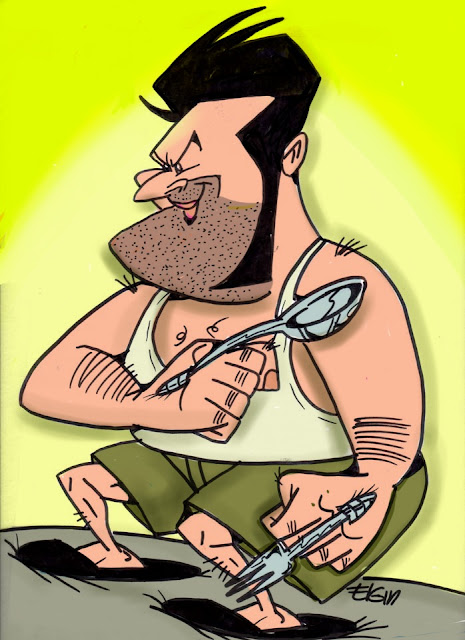

This picture is a revised version of my subject in the top photo. Its taken from a lecture that I gave at a NYC DARE TO DRAW/DRINK AND DRAW presentation I gave on the art of character design.This picture was eventually used as the cover for an ebook of mine on the art of character design. The ebook is available for purchase on this blog in the Ebooks and products section in the upper right corner
THE ART OF TEACHING ART by Elgin SUBWAYSURFER Bolling

There comes a time in every professional artists life when you absolutely, positively MUST speak/teach in front of a group. That group may be a group of public school kids on career day, a continuing education course at The Learning Annex, or community college, or a seminar like I'm teaching in the above photo.
WHY MUST YOU DO THIS?
Actually there are a number of reasons why doing this is beneficial to your career. Among them are:
NOTORIETY AND VISIBILITY
Let's face it, no matter how good you are as an artist, in the public mind "artists are a dime a dozen." most people "know"someone who can draw, or think one artist, is just as good as another. Part of the reason for this erroneous public perception is due to the way most artists present themselves, or rather don't present themselves. For the most part, art is a solitary activity, which takes a lot of time to create. Because we artists spend a lot of tmrw focusing on our work, we may not spend an equal amount of time focusing on, and interacting with people. I've met artists whose work is brilliant, visually but whose personalities seem to evaporate when they have to explain it to someone. Most feel that their work should "speak for them". However, in the non artist world, people make themselves known by speaking for themselves.
In order to stand out from the art crowd, you must become adept at speaking for yourself. You must be able to transfer, and impart what you know to other people. So few artists are able to do this, that those who can, will be the ones who stand out and will be remembered.
A GREAT WAY TO GET NEW CLIENTS
Another benefit of teaching/public speaking is that it's a great way to get clients. Even if you give a free seminar,you never know who is in the audience listening. Often times another person will hear you speak and present, and will be impressed enough to hire you for a business venture they are involved in. This is precisely what landed me a job with EHOW.COM where I was commissioned to do 90 instructional videos entitled "drawing 101" for children. Potential clients are always on the lookout for people who can speak and present well.
FINANCIAL REWARD IN LEAN TIMES
It's great to have a client with deep pockets who keep you afloat, but all good things eventually come to an end, and you will be out of a job, wondering where the next one is coming from. Teaching fills in the gaps, and if you are popular, your teaching gig can last for months. Seminars and workshops can also be lucrative. The great thing about doing a workshop is that you Jacobs total control over what you want to present.
THIS ALL SOUND GOOD, BUT IM SCARED TO DEATH OF PUBLIC SPEAKING!! HOW CAN I TEACH WHEN IM AFRAID TO SPEAK?
I've read thar public speaking is the number one fear most people have and number two is the fear of DEATH! So speaking in front of a group for most people, is close to dying! Trust me, I feel your pain! I can assure you though, that it s possible to get over this fear even if you are an introvert like I was.
WANNA KNOW MORE?
Read part two of this article!
Tuesday, January 10, 2012
THE7 HABITS OF HIGHLY EFFECTIVE ARTISTS by Elgin SUBWAYSURFER Bolling
7 HABITS OF HIGHLY EFFECTIVE ARTISTS
By Elgin Subwaysurfer Bolling
(Apologies to Franklin Covey)
So there I was, reading Franklin Covey's fascinating book, The 7 Habits of Highly Successful People, and as usual, my creative mind began to free associate as I went down Covey's list. Although I've done a tongue-in-cheek play on words of the principles, these really are habits of highly successful artists that I've read about,come in contact with, and implemented myself.
Enjoy.
1 BE ACTIVE PROFESSIONALLY
When I was a younger artist, I loathed alliances of any kind. "they're not going to steal my clients!""they're not going to steal my ideas!" I said to myself, and I did make decent money. But I was lonely and unfulfilled. As I got older, I realized the power and practicality of aligning myself with other professionals like myself, and being active in organizations. Not only did active participation make me a better artist, but t also created a sense of community in a profession that is solitary. Oh, did I mention that my income did not suffer?
2 BEGIN WITH NO END IN SIGHT
In regards to working, I've found that you create an infinite amount f stress when you're always focussing on the END of the project rather than enjoying the process, the journey. Whenever I forget about clock watching, I get into a creative zone where I become so involved that I get much more work done, with Kessler stress.
3 PUT FIRST THINGS LAST
Most people focus primarily on the thing they do best FIRST rather than working on their weaknesses. That's putting first things first. Try saving the first easy thing for LAST, and you'll find you'll gain more control over the stuff you're bad at.
4 THINK GRIN/GRIN
There's nothing worse than coming out of a. Negotiation or business deal where you're happy but your client isn't, or even worse, when your clients happy, and you aren't! Both scenarios will not get you repeat a referral,or repeat business from that client, and that is what need if you are to make a living as a professional artist.
I would refer to these as GRIN/FROWN scenarios.
In GRIN/GRIN scenarios you seek to walk away from a business meeting where you both are satisfied. To achieve this takes compromise, business savvy, the gift if gab, a d even a little luck, but it can be done, and a client who is Grinning is sure to eel you winning. (their money, that is!)
5 SEEK FIRST TO UNDERSTAND, THEN YOU WILL BE IN DEMAND
I've always been turned off by salespeople and business professionals who just look at e like I'm a dollar sign. These types never ask my opinion, keep firing questions at me, without giving me time to respond, or if I have objections, mentally write me off as not being a potential paycheck. I've found that if I seek to understand my clients needs, objections, fears, and concerns, not only does it make my work with them easier, but they also end up purchasing a lot more from me than they normally would, people haye to be treated like statistical data. Threat them like human beings and you'll be in demand.
6 PRIORITIZE
As an artist, it's natural to be loose, carefree, and spontaneous. Much if the creative process has that air of unpredictability, it's how we find our muse. Once that muse is found, though, it's time to take off the"artists hat" and put on the "business person hat."
You will never get a project done in a timely fashion for a client unless you prioritize. As a young artist I literally avoided some business projects because I felt they were too "labor intensive" and instead did my "fun"stuff first, vowing I'd get to the hard stuff once relaxed. I remember many a sleepless night burning the proverbial "midnight oil" in an effort to get my "labor intensive "
7 SHARPEN YOUR FLAW
Before Arnold was Governor of California, he was a world champion bodybuilder. Seven times mr Olympia in fact, beating out consistently world class competitors all over the globe. Arnold boasted that he won consistently because he ad no weak parts, which was not just an arrogant boast. In professional bodybuilding, the top competitors are judged, objectively on how well proportioned each particular muscle group is in relationship to the entire body. Although it's true that Arnold's charismatic personality didn't hurt his chances for obtaining victory, objectively, he was found to be "perfectly proportioned"according to competitive standards. However, this wasn't always the case. In a candid interview, Arnold revealed that early in his competitive career,his physical flaw was his calve muscles, which he referred to as weak, and constantly lagged behind the rest of his body in terms of continued growth. To improve, he purposely wore pants cut off that only revealed his weak skinny calves. Doing this forced him to work even harder on their development since he was forced to constantly look at them. Arnold didn't run away from his flaw pretending it didn't exist, but continued to sharpen it working assiduously unlit it was no longer a weakness,but one of his strengths.
As artists we too must not run away from our weaknesses but sharpen them into strengths. I recall early on having terrible line qality when I drew, as was pointed out by a fellow artist I respected. I practiced continuously until I got to the point where I actually became sought after BECAUSE of my great line quality!
By Elgin Subwaysurfer Bolling
(Apologies to Franklin Covey)
So there I was, reading Franklin Covey's fascinating book, The 7 Habits of Highly Successful People, and as usual, my creative mind began to free associate as I went down Covey's list. Although I've done a tongue-in-cheek play on words of the principles, these really are habits of highly successful artists that I've read about,come in contact with, and implemented myself.
Enjoy.
1 BE ACTIVE PROFESSIONALLY
When I was a younger artist, I loathed alliances of any kind. "they're not going to steal my clients!""they're not going to steal my ideas!" I said to myself, and I did make decent money. But I was lonely and unfulfilled. As I got older, I realized the power and practicality of aligning myself with other professionals like myself, and being active in organizations. Not only did active participation make me a better artist, but t also created a sense of community in a profession that is solitary. Oh, did I mention that my income did not suffer?
2 BEGIN WITH NO END IN SIGHT
In regards to working, I've found that you create an infinite amount f stress when you're always focussing on the END of the project rather than enjoying the process, the journey. Whenever I forget about clock watching, I get into a creative zone where I become so involved that I get much more work done, with Kessler stress.
3 PUT FIRST THINGS LAST
Most people focus primarily on the thing they do best FIRST rather than working on their weaknesses. That's putting first things first. Try saving the first easy thing for LAST, and you'll find you'll gain more control over the stuff you're bad at.
4 THINK GRIN/GRIN
There's nothing worse than coming out of a. Negotiation or business deal where you're happy but your client isn't, or even worse, when your clients happy, and you aren't! Both scenarios will not get you repeat a referral,or repeat business from that client, and that is what need if you are to make a living as a professional artist.
I would refer to these as GRIN/FROWN scenarios.
In GRIN/GRIN scenarios you seek to walk away from a business meeting where you both are satisfied. To achieve this takes compromise, business savvy, the gift if gab, a d even a little luck, but it can be done, and a client who is Grinning is sure to eel you winning. (their money, that is!)
5 SEEK FIRST TO UNDERSTAND, THEN YOU WILL BE IN DEMAND
I've always been turned off by salespeople and business professionals who just look at e like I'm a dollar sign. These types never ask my opinion, keep firing questions at me, without giving me time to respond, or if I have objections, mentally write me off as not being a potential paycheck. I've found that if I seek to understand my clients needs, objections, fears, and concerns, not only does it make my work with them easier, but they also end up purchasing a lot more from me than they normally would, people haye to be treated like statistical data. Threat them like human beings and you'll be in demand.
6 PRIORITIZE
As an artist, it's natural to be loose, carefree, and spontaneous. Much if the creative process has that air of unpredictability, it's how we find our muse. Once that muse is found, though, it's time to take off the"artists hat" and put on the "business person hat."
You will never get a project done in a timely fashion for a client unless you prioritize. As a young artist I literally avoided some business projects because I felt they were too "labor intensive" and instead did my "fun"stuff first, vowing I'd get to the hard stuff once relaxed. I remember many a sleepless night burning the proverbial "midnight oil" in an effort to get my "labor intensive "
7 SHARPEN YOUR FLAW
Before Arnold was Governor of California, he was a world champion bodybuilder. Seven times mr Olympia in fact, beating out consistently world class competitors all over the globe. Arnold boasted that he won consistently because he ad no weak parts, which was not just an arrogant boast. In professional bodybuilding, the top competitors are judged, objectively on how well proportioned each particular muscle group is in relationship to the entire body. Although it's true that Arnold's charismatic personality didn't hurt his chances for obtaining victory, objectively, he was found to be "perfectly proportioned"according to competitive standards. However, this wasn't always the case. In a candid interview, Arnold revealed that early in his competitive career,his physical flaw was his calve muscles, which he referred to as weak, and constantly lagged behind the rest of his body in terms of continued growth. To improve, he purposely wore pants cut off that only revealed his weak skinny calves. Doing this forced him to work even harder on their development since he was forced to constantly look at them. Arnold didn't run away from his flaw pretending it didn't exist, but continued to sharpen it working assiduously unlit it was no longer a weakness,but one of his strengths.
As artists we too must not run away from our weaknesses but sharpen them into strengths. I recall early on having terrible line qality when I drew, as was pointed out by a fellow artist I respected. I practiced continuously until I got to the point where I actually became sought after BECAUSE of my great line quality!
Subscribe to:
Posts (Atom)